The Digital Euro and Merchants Minimal Effort: New Rules of the Game
With the digital euro, a public payment infrastructure is emerging in Europe that affects all key players in the payments industry. The previous instalments in this series looked at the supply and distribution side: the banks, the payment service providers, and stablecoins as a private alternative. This instalment shifts perspective to look at the acceptance side: retail.

The digital euro ranks among the largest regulatory undertakings in European payments since the introduction of euro cash. Yet ask merchants what the project means for them, and the response is often a shrug: just another payment method among many, nothing more. From an operational standpoint, that reaction is even justified. But it falls short.
Because unlike any card, wallet, or real-time solution of the past two decades, the digital euro arrives with a feature that is so far unique among digital means of payment and otherwise found only in cash: a statutory obligation to accept it. Precisely where little changes operationally for retailers, the rules of the game shift: at the checkout4, in the cost structure, and in the negotiating position vis-à-vis established providers.
This article is aimed at decision-makers in retail and everyone who shapes payment processes. It examines the real effort involved in a differentiated way relative to its strategic impact and sets out what the digital euro means for retail, operationally, economically, and technically. At its core is the question:
What does the digital euro mean for merchants, and how much does it really change at the checkout?
What Merchants Pay for Payments Today
Before assessing what the digital euro will change for retail, it is worth looking at the starting point: What does payment cost retailers today, and how is this market structured?
Every non-cash payment generates costs for the merchant that are made up of several components. Using card payments as an example (still the most expensive rail merchants can't do without in brick-and-mortar retail), the cost stack can be shown clearly; it breaks down essentially into four blocks:
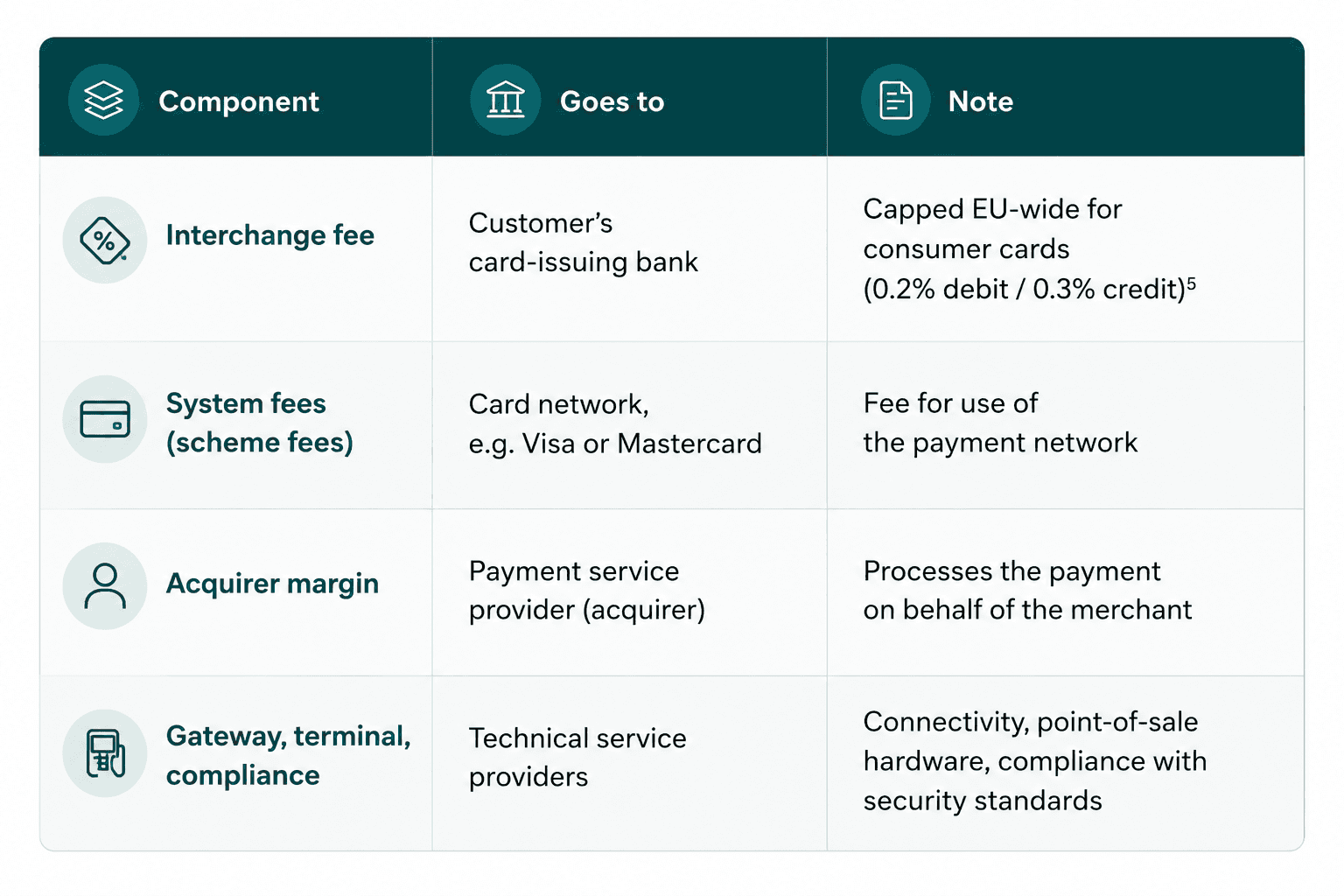
For the merchant, these components usually merge into a single figure: the so-called merchant discount rate (MDR): the share of every transaction that goes toward payment processing. How high this fee turns out to be, however, depends heavily on negotiating position, and this is precisely where a key dividing line runs through the market.
Large retail chains process enormous volumes and can negotiate their terms with payment service providers. Small and medium-sized merchants, by contrast, mostly accept the standard terms set by their provider. The same payment therefore often costs large retailers noticeably less than small shops. This asymmetry matters: it is decisive for how the digital euro will later affect different merchants.
Payments, however, are anything but uniform. At the physical point of sale, cards dominate. In online retail, the share of methods where payment goes directly from account to account is growing5 (so-called A2A payments6), as is the share of payment services and wallets. And in countries such as Germany7, Austria, Italy, or Spain, cash remains a fixed feature, despite all the digitalization. Retailers therefore already juggle a wide variety of payment channels today, each of which comes with its own costs, interfaces, and habits.
This starting point is the benchmark against which the digital euro must be measured for retail. The decisive question, therefore, is not whether it works technically, but whether it will be cheaper, simpler, or more independent of individual private providers for retailers than what already exists.
Mandatory Acceptance, But Little Changes Operationally
Let us begin with the observation that explains the shrug described at the outset, and which is essentially correct: operationally, the digital euro is barely a challenge for retailers. The real burden falls on banks and payment service providers (PSPs8). They operate the wallets, verify identities, ensure the connection to the Eurosystem's central settlement platform (DESP9) and bear the regulatory responsibility. For the merchant, the digital euro is thus an additional payment method that their existing provider connects, just as a new card or a new wallet is added today. There is no obligation to run their own wallet, no direct connection to the central bank, no elaborate onboarding. In fact, the rollout of Apple Pay or Klarna was operationally more demanding for many merchants than the digital euro is likely to be.
So far, so unspectacular. What sets the digital euro apart from every payment innovation of recent years has little to do with implementation effort: Existing forms of payment via cards, wallets, real-time transfers, or stablecoins are accepted by merchants voluntarily. Anyone who doesn't want to accept Mastercard doesn't have to. The digital euro, by contrast, is set to receive the status of legal tender, with a fundamental obligation to accept it. As a digital means of payment, it thus has a characteristic that until now only cash possessed.
The underlying regulatory proposal from the European Commission10 provides that merchants must generally accept the digital euro if they accept electronic payments, with exceptions, for example, for very small businesses without comparable electronic payment methods, for private individuals outside a commercial activity, and for a good-faith refusal. The exact design is the subject of the ongoing legislative process and has not yet been finally decided. What matters is the scope: for the first time since the introduction of the euro, the merchant alone no longer decides whether to offer a digital means of payment. And this obligation applies not only at the physical point of sale but explicitly also in online retail: a break with the previously self-evident principle that in e-commerce every merchant freely chooses their own payment methods.
One distinction is worth making here to avoid a misunderstanding: obligation means acceptance, not preference. The merchant must permit the digital euro, but need not highlight, promote it, or place it first. What sounds like a legal nuance is the lever on which the real dynamic actually turns.
The Checkout Economics Are Shifting
If the digital euro changes little operationally but must be accepted as a matter of obligation, the question arises of where its impact actually lies. The answer begins at a place every merchant knows and carefully designs: the checkout.
The checkout is a limited stage. Whether at the till or in the online payment process, the space for payment options is finite, and so is the customer's attention. E-commerce experience shows that an overloaded payment process can hurt the conversion rate: the more competing options a customer sees, the more likely they are to hesitate or abandon the purchase. Merchants therefore curate their payment methods deliberately and rarely show everything that is technically possible.
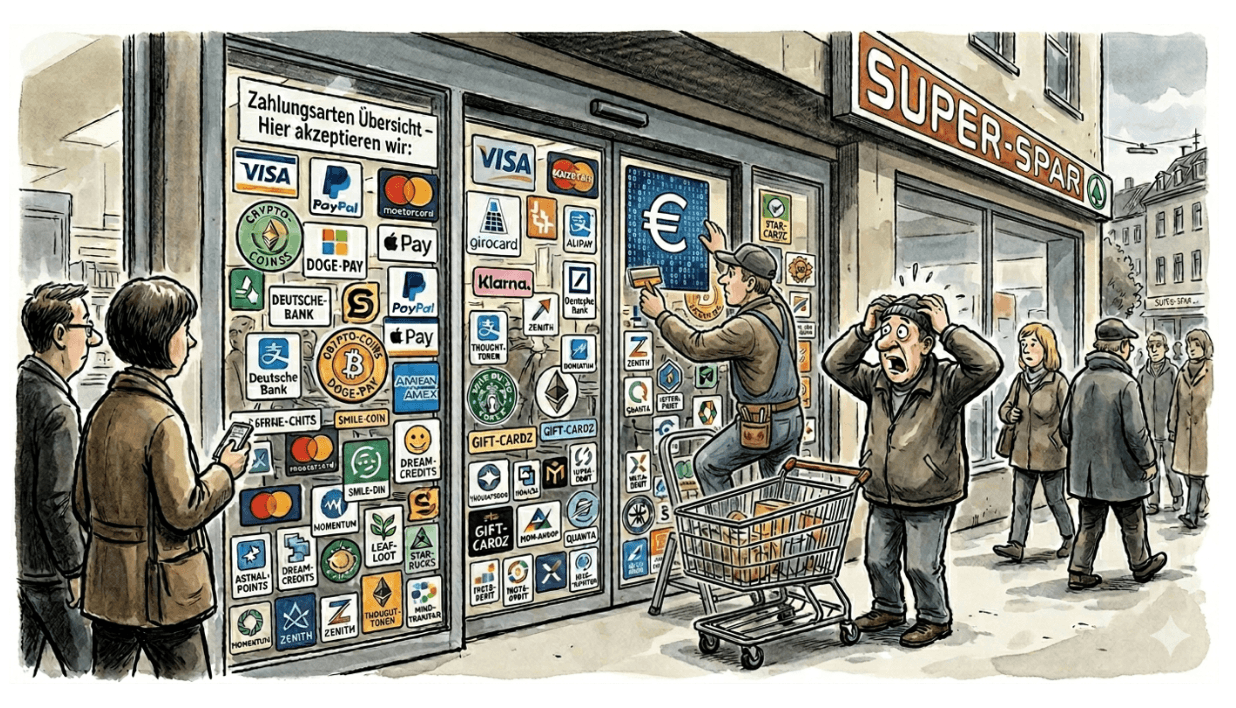
Into this curated selection now enters a player that cannot be left out. True, the obligation to accept (as described in the previous chapter) requires only acceptance, not preference. Exactly how visible this acceptance must be at an online checkout, whether as a prominent button or as one option among several, has not yet been conclusively settled by regulation. But as soon as the digital euro can claim a fixed place, the balance shifts: whatever is added potentially displaces something else. The only question is what.
One thing changes decisively: retail's negotiating position. Against the major card networks or the operators of established wallets, merchants today have only limited leverage; the reach of these providers is simply too great to do without them. A cost-effective, publicly backed alternative at the checkout changes this baseline. Merely the credible possibility of pushing the digital euro further into the foreground gives retail an argument it did not have before.
Closely related to this is the mix of payment costs. The ECB aims to ensure that merchant fees for the digital euro do not exceed those of comparable private payment methods; the exact pricing structure, however, remains open. Should this goal be realized, the average share a merchant spends on payment processing will shift, simply because part of the transactions run over a cheaper rail. The merchant needs to do nothing more for this than accept the payment.
This effect, however, is distributed asymmetrically: here the dividing line described in Chapter 2 returns. Small and medium-sized merchants, who today pay full standard terms, would have the most to gain, for them, a regulated, low-cost means of payment would be a direct cost lever. Large retail chains with already low, negotiated terms benefit less on the cost side. For them, the value lies more in the strategic steering of their own payment mix and in a strengthened negotiating position vis-à-vis established providers.
There is also a gain in independence: for the first time, a digital means of payment exists that is not tied to the infrastructure of a private provider and that reduces dependence on individual platforms. For retail, that means less lock-in to individual platforms whose terms it must largely accept today.
These effects, however, are subject to a double caveat: they depend on the final pricing and on how strongly the digital euro is actually used in everyday life. How many consumers will pay with it in future remains open today: a topic to which a further instalment of this series will be dedicated. Yet the most important lever, the changed negotiating position, does not depend on high usage figures. The mere existence of a credible public alternative is enough to change the rules of the game. The structural shift therefore occurs in any case, regardless of how many customers ultimately choose the digital euro.
Where Something Does Change Operationally
The thesis that little changes operationally for retail broadly holds true. But there are three exceptions every merchant should know, because they concern processes that are so taken for granted today that their change is easily overlooked.
The first concerns refunds. With card payments, a refund, depending on timing and card type, can be a genuine reversal of the original transaction or already a separate counter-entry. With the digital euro, only the second case applies: because a completed payment is final (the technical background follows in the next chapter), a refund is always a separate new payment from the merchant back to the customer, never the unwinding of the original one. This has practical consequences: in the accounts, the refund is not offset against a cancelled original transaction but recorded as its own payout transaction. Customer service must actively initiate a repayment rather than simply releasing one. And the merchant must still be able to address the original buyer at all, even though, as will be shown later, they see only a pseudonymous reference to that buyer. This reference must therefore still be available at the time of the refund so that a later refund or partial refund remains possible.
The second exception is the absence of a chargeback mechanism. With card payments, customers can dispute a payment; the bank then claws the amount back from the merchant. This clawback route does not exist with the digital euro. A completed payment flows in one direction; there is no way back unless the merchant actively decides to repay it themselves. For retail, this has two opposing sides. On the one hand, a noticeable risk disappears: chargebacks and their associated costs, which weigh heavily today especially in online retail, fall away. Money received stays money received. On the other hand, this also removes a protection mechanism that customers rely on today. The chargeback is, for many, a familiar safety net that builds trust in the purchase. With the digital euro, disputes are instead resolved through procedures handled by payment service providers under the Eurosystem's rules, not according to the logic of the card networks. The disappearance of the chargeback therefore cuts both ways for retail: relief on chargeback costs, but the loss of a mechanism that has so far given customers security, and, with it, purchase confidence.
The third exception concerns the reconciliation of incoming payments. Incoming digital euro are made available to the merchant via their business bank account; unlike end customers, a merchant holds no digital euro balances of its own. In everyday practice, the payment process therefore remains familiar: the money lands on the current account as usual. The underlying logic, however, is different, and the data records used to document these receipts are new. Accounting systems and processes must therefore be able to cleanly map the new payment method, even though the end result looks familiar.
Individually, none of these three changes amounts to a major undertaking. Together, they trace back to a single cause: the finality of a payment and the particular structure of the digital euro. How these come about technically (how the payment reaches the merchant and how settlement and account crediting work) is the subject of the following chapter.
How the Digital Euro Reaches the Merchant
The previous chapter showed that something changes in refunds, dispute resolution, and reconciliation. This chapter explains why and how the digital euro technically reaches the merchant at all.
The starting point is decisive and, at the same time, reassuring: the merchant does not connect directly to the Eurosystem's central settlement platform (DESP). Their point of contact remains the acquirer, that is, the payment service provider that already processes their card payments today. That is where onboarding into the system and verification of the merchant's business identity (KYB11) sit, along with the contract. The digital euro brings new certification and forwarding obligations for the service provider, but no new, direct connection to the central bank for the merchant.
A single characteristic shapes almost everything that defines the digital euro from a merchant's perspective, and it explains the particularities described in the previous chapter. The digital euro is central bank money that is transferred with immediate finality, similar to handing over cash. The customer releases the payment from their wallet, the amount flows to the merchant, and with that it is complete. Unlike a card payment via the international networks of Visa or Mastercard (somewhat different processes apply to the domestic Girocard), where the merchant's acquirer collects the amount via the card network, there is no such direct debit here that a bank could later reverse. Much follows from this finality: without a direct debit there is no reversal of a direct debit, and therefore neither a classic cancellation nor a chargeback. A refund must therefore take the form of a new payment in the opposite direction. What was described in Chapter 5 as a business-operational peculiarity has its technical root here.
In online retail, a payment presumably works as follows: the shop calls the payment via the interface (API12) of its payment service provider. The customer is directed to their digital-euro wallet, releases the payment there, and authenticates securely, via the strong customer authentication (SCA13) familiar from online banking. Once released, the wallet sends the payment, the amount is processed, and credited to the merchant. For connecting to common shop systems such as Shopify, Magento, or WooCommerce, payment service providers are likely to provide ready-made plug-ins, as they do today for other payment methods. The merchant thus essentially only needs to activate the digital euro, rather than build any elaborate technical integration.
At the physical point of sale, the digital euro fits into existing hardware. Existing payment terminals will presumably be extended via a software update with an additional payment application for the digital euro, sitting alongside the card applications. For the customer, it is the same contactless gesture as with a card payment; in the background, the terminal decides which rail the payment runs over. Merchants without a classic terminal have two simpler options: payments via QR code, which the customer scans with their wallet, or so-called soft-POS solutions14, where an ordinary smartphone replaces the terminal. Especially for small merchants, this significantly lowers the entry barrier.
A significant difference from all other digital forms of payment is offline acceptance: the ability to accept a payment even without an internet connection. It is one of the special features of the digital euro, but it places higher demands on the hardware: the receiving device needs a secure, tamper-resistant component (a "secure element"), and the acquirer must confirm that the device is trustworthy. Because an offline payment cannot be checked immediately in real time, limits apply, for example per transaction and for the total sum of amounts accepted offline. As soon as the device is back online, these payments are reconciled with the system retroactively. For most merchants, offline acceptance is not a must-have; for some, such as at events or in places with weak network coverage, it is a genuine advantage.
That leaves the question of what the merchant actually sees of their customer. The answer: not much. Instead of full account details, they receive only a pseudonymous reference to the payer, comparable to the tokenization logic that "Apple Pay", for example, already uses today to hide the actual card number. Unlike with cards, however, stricter data-protection requirements apply to the digital euro, particularly for small amounts and offline payments, where a cash-like degree of confidentiality is being pursued. The merchant must retain this pseudonymous reference in order to be able to match a later refund to the correct transaction.
For the merchant, the technical footprint remains small. The demanding parts (wallet operation, real-time verification, connection to the Eurosystem, certification) sit with the payment service provider. What the merchant needs is essentially an updated integration and, depending on the channel, an adjustment to the terminal or shop system. This confirms the opening thesis: the effort is manageable; the digital euro's real impact unfolds elsewhere.
Strategic Outlook
The digital euro will not be retail's next big IT project, but it reshuffles the deck at the checkout. Its impact does not stem from integration effort but from changed framework conditions: a mandatory method, a potentially cheaper rail, and a public alternative that belongs to no one alone.
Not every merchant gains the same amount. Small and medium-sized merchants gain mainly on the cost side: a regulated, low-cost means of payment gives them a low price they could never have negotiated themselves. Large retail chains gain less on fees, but gain a new variable in their payment mix and likewise a lever against card networks and wallet providers. This lever does not depend on high usage figures: the mere existence of a credible public alternative changes the notiation basis.
That is precisely why the checkout will in future no longer be just a question of conversion, but also one of regulation. Anyone who plans it purely around cost and completed purchases overlooks that one of the methods on offer is no longer theirs to choose.
For merchants, this results in less a project than a matter of attention, in three places:
Check terms early. Fee structure, contract clauses, and how refunds are handled largely determine the economic impact of the digital euro. Large merchants can negotiate them; smaller ones should at least compare offers from different providers and use the competition while market standards are still in flux, rather than accepting the first standard package unseen.
Steer the payment mix deliberately. Which payment method is visible today and why (because of margin, conversion, or simply customer habit) and what happens when the digital euro is added should be a conscious decision. Anyone who just lets it "tag along" gives away its cost advantage and leaves it to others to decide which method ultimately gets the click.
Prepare the operational interfaces. Refunds as new payments, the absent chargeback, and changed reconciliation raise follow-on questions in accounting, service, and complaints handling. Anyone who only sorts these out at launch risks avoidable friction, of all things, with a means of payment that arrives with the promise of public reliability.
The added value of the digital euro for retail will be decided during the preparation that precedes launch, not on launch day itself.
Conclusion
At the outset stood the merchants' shrug: the digital euro, just another payment method among many. After everything this article has shown, that reaction is both right and misleading. The reaction is fair on the operational level: the burden lies with banks and payment service providers, and the merchant simply has their provider connect one more payment method, nothing more. But an operational lens alone misses the real point.
Because the digital euro does not shift the effort involved, but the rules of the game. With the obligation to accept it, for the first time retail no longer alone decides which digital payment appears at the checkout. With a potentially cheaper, publicly backed rail, the mix of payment costs shifts, and with it the negotiating position vis-à-vis card networks and wallet providers, entirely regardless of how many customers ultimately choose the digital euro. This article thus fits the pattern of the whole series: from the perspective of banks, payment service providers, and now retail, the same core emerges: the digital euro is less a technical project than a structural one, a question of control and independence.
This shift will not happen overnight. The digital euro will, at the earliest, become broadly effective toward the end of the decade, time that remains for retail to prepare, but that should also be put to use. And everything described here remains subject to the final regulatory design and actual market acceptance. The direction, however, is foreseeable, and it leads to a place that retail has, until now, controlled itself:
The digital euro demands little effort from retail, yet the rules of the game are changing, joined by one more player: the ECB.